

Every year, roughly 38,000 students walk out of Kerala's engineering colleges with a degree in hand. Ask any of them what they want, and a large share will say the same thing: a job at a recognizable MNC, ideally without having to leave home. Technopark, Infopark, and Cyberpark exist precisely because that demand is real — but how many people actually get there?
This piece works through the numbers, using publicly available data on KEAM seat intake, AICTE approvals, KTU enrollment, IT park employment figures, and company hiring announcements. Where official numbers don't exist — and for several parts of this pipeline, they simply don't — the gaps are estimated using reasonable proxies and flagged clearly. Treat the percentages as directional, not gospel.
Step 1: How Many Engineers Does Kerala Actually Produce?
Kerala has 177 AICTE-approved engineering colleges — about 30-35 government/government-aided institutions and 130-140 self-financing private colleges — offering a combined sanctioned intake of roughly 56,000 B.Tech seats a year through KEAM. In practice, around 20,000 of those seats go unfilled every year due to declining demand for engineering as a first choice, particularly in private colleges and non-CSE branches.
Net effect: Kerala actually admits roughly 36,000 students a year, and cross-checking against KTU's total enrollment (160,000+ students across 170+ affiliated colleges, divided by the 4-year program length) lands in the same range. Rounding for later-stage attrition and backlogs, the realistic annual output is:
~38,000 engineering graduates per year.
Step 2: Which Branches Are They Actually In?
Not all 38,000 are the same kind of engineer, and the branch mix matters a lot for what comes next. Computer Science and its offshoots (AI & Data Science, Cybersecurity, CSBS) have been eating into the share once held by core branches like Civil and Mechanical, driven by both student demand and colleges converting seats to computing-adjacent programs.
| Stream | Estimated share | Graduates/year |
|---|---|---|
| Computer Science & Engineering (CSE) | 30% | 11,400 |
| CSE allied (AI&DS, AI&ML, Cybersecurity, CSBS, IoT) | 12% | 4,600 |
| Electronics & Communication (ECE) | 15% | 5,700 |
| Mechanical Engineering | 12% | 4,600 |
| Electrical & Electronics (EEE) | 8% | 3,000 |
| Civil Engineering | 8% | 3,000 |
| Information Technology (IT) | 5% | 1,900 |
| Other (Chemical, Biomedical, Aeronautical, Robotics, etc.) | 10% | 3,800 |
| Total | 100% | ~38,000 |
Nearly half the graduating class — CSE plus its allied programs plus IT — is now chasing software-track jobs. That matters, because it's exactly the pool MNCs in Kerala are hiring from.
Step 3: How Many MNC Jobs Actually Exist Inside Kerala?
This is where the analysis gets interesting, and where the honest answer is: nobody publishes this number. No company discloses "freshers hired in Kerala, per year." What follows is built from public headcount figures, national fresher-hiring announcements, and IT park employment scale — not leaked or official statistics.
Kerala's MNC employment is concentrated in three IT parks: Technopark (Trivandrum, 500+ companies, ~80,000 employees), Infopark (Kochi, 450+ companies, ~55,000 employees), and Cyberpark (Kozhikode, a smaller and newer hub). The major tenants are familiar names — TCS, Infosys, UST Global (headquartered in Trivandrum), Wipro, Cognizant, Accenture, HCLTech, Tech Mahindra, IBM, and a long tail of finance-tech and consulting firms like KPMG, EY, Tata Elxsi, and Allianz.
Deliberately excluded from this count: campus drives by Amazon, Microsoft, Google, and Adobe (which place Kerala students in Bengaluru or Hyderabad), and core-sector recruiters like L&T, Bosch, TVS, and JSW (which post graduates to plants outside the state). Those are real hiring channels for Kerala engineers, but they're not jobs in Kerala — which is the question this piece is actually answering.
| MNC | Kerala office | Est. freshers hired/year (in-state) |
|---|---|---|
| TCS | Technopark + Infopark | ~1,500 |
| UST Global | Trivandrum HQ | ~1,000 |
| Cognizant | Infopark | ~600 |
| Accenture | Infopark/Technopark | ~600 |
| Wipro | Infopark | ~500 |
| Infosys | Technopark | ~500 |
| HCLTech | Infopark | ~400 |
| Tech Mahindra | Infopark | ~400 |
| IBM | Infopark | ~300 |
| Others (KPMG, EY, Xerox, Conduent, EXL, Tata Elxsi, Envestnet, Guidehouse, etc.) | Technopark/Infopark | ~1,500 |
| Total in-Kerala MNC absorption | ~7,300/year |
Step 4: So, What Are Your Actual Chances?
Putting supply and in-state demand side by side gives a stream-wise absorption rate — the rough odds that a graduate in a given branch lands an MNC job without leaving Kerala.
| Stream | Graduates/year | In-Kerala MNC jobs/year | Absorption rate |
|---|---|---|---|
| IT | 1,900 | ~580 | ~31% |
| ECE | 5,700 | ~1,460 | ~26% |
| CSE allied (AI&DS, Cyber, CSBS) | 4,600 | ~1,100 | ~24% |
| CSE (core) | 11,400 | ~2,550 | ~22% |
| EEE | 3,000 | ~580 | ~19% |
| Mechanical | 4,600 | ~510 | ~11% |
| Other | 3,800 | ~290 | ~8% |
| Civil | 3,000 | ~220 | ~7% |
| Overall | ~38,000 | ~7,300 | ~19% |
One nuance worth flagging: IT-services majors like TCS, Infosys, Wipro, and Cognizant typically hire "any branch" for software roles, training non-CSE graduates in-house. That's part of why EEE and Mechanical grads still register a non-trivial absorption rate above — it isn't purely a CSE story, even if CSE dominates.
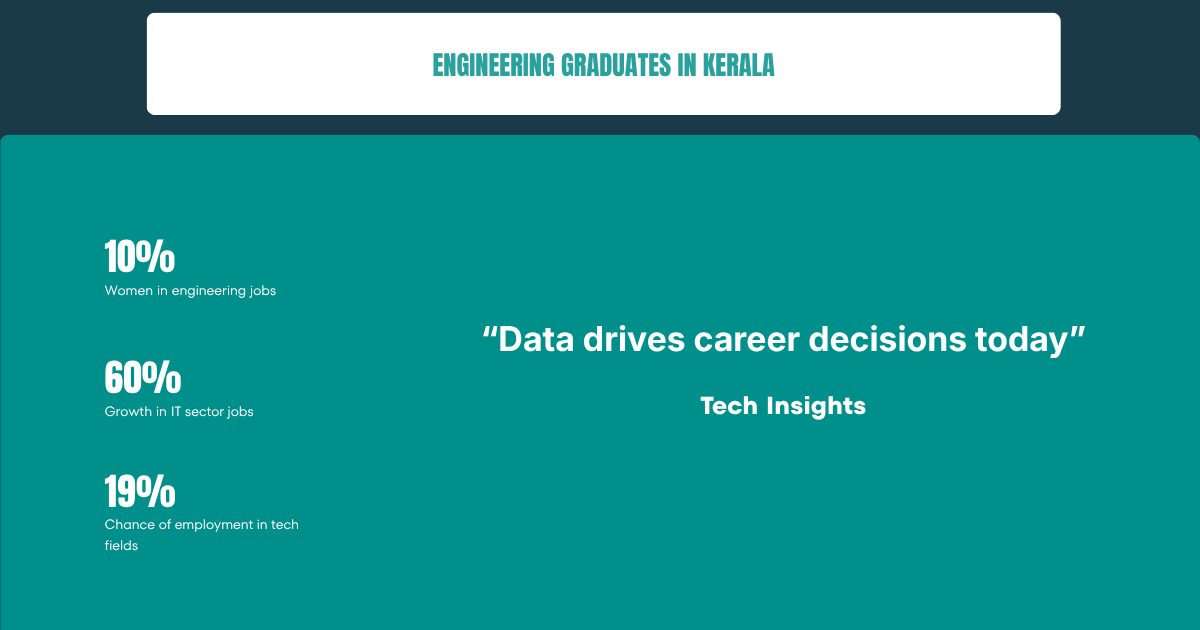
The headline number: roughly 1 in 5 graduating engineers (about 19%) gets an MNC job physically located inside Kerala in their graduating year. If you're in IT, ECE, or a CSE-adjacent stream, your odds are closer to 1 in 4. If you're in Civil or Mechanical, they drop to somewhere between 1 in 10 and 1 in 15.
Where Does the Other 80% Go?
Not into unemployment — into paths this analysis simply didn't count. That includes MNC jobs at the same companies but posted outside Kerala (Bengaluru, Chennai, Hyderabad, Pune, or overseas), smaller local IT/ITES firms that never make an MNC list, PSU and government-sector roles, higher studies (M.Tech, MBA, or a master's abroad), and non-core jobs unrelated to the engineering degree altogether. Anecdotally and by most placement-cell accounts, out-of-state MNC placement is actually a bigger channel than in-state — but it isn't captured in the "stay in Kerala" framing of this piece.
The Honest Caveat
Every number after "38,000 graduates" in this piece is a modeled estimate, not an official statistic. No Kerala government department, AICTE, KTU, or any individual MNC publishes branch-wise or state-wise annual fresher hiring data. The figures here were built by combining KEAM seat-matrix data, IT park employment scale, and national fresher-hiring announcements, scaled down to a Kerala-specific estimate. They're a reasonable planning signal, not a citable government census — worth remembering before quoting the 19% figure as fact.
Data sources: CEE Kerala (KEAM 2025 seat matrix and allotment data), AICTE-approved college listings, APJ Abdul Kalam Technological University (KTU) enrollment figures, Technopark Trivandrum and Infopark Kochi public employment figures, and public fresher-hiring announcements from TCS, Infosys, and other listed companies.
Comments
0Sign in to comment
Please sign in with Google to leave a comment
Sign In with Google