
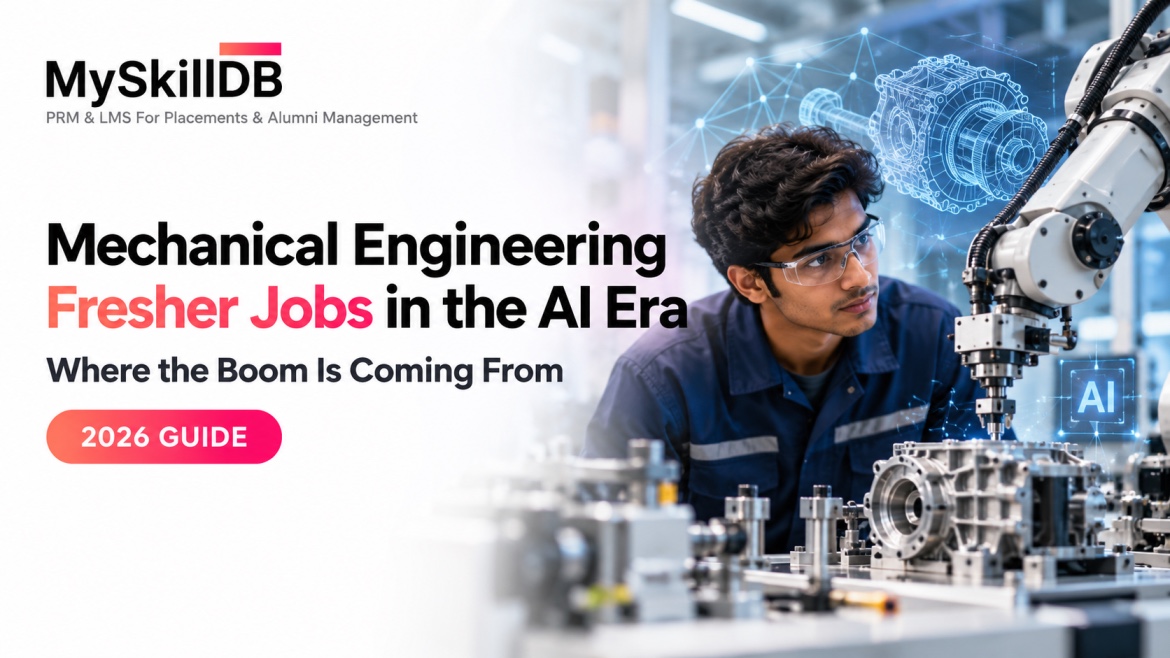
Every placement season, mechanical engineering students hear the same worry: "AI is coming, and core jobs are drying up." The data in 2026 tells a different story. AI is not shrinking mechanical engineering. It is splitting it into two tracks: freshers who can only draft and follow routine, and freshers who can work with data, simulation and smart machines. The second group is in short supply.
This guide breaks down where the fresher roles are, why AI is creating demand rather than killing it, and what a mechanical student should do in each year of college to be ready.
Is AI really replacing mechanical engineers?
Short answer: it is replacing tasks, not the engineer. Repetitive CAD drafting, manual inspection and paper-based maintenance logs are being automated. But someone still has to understand stresses, tolerances, heat transfer, materials and manufacturing processes, then decide what the AI output means on a real shop floor. That someone is a mechanical engineer.
Hiring signals back this up. TeamLease EdTech's Career Outlook Report for the first half of 2026 put fresher hiring intent at 73% (source). Freshers are still being hired. What has changed is the skill profile companies expect.
Why the boom is coming: AI is moving into factories
The biggest driver for mechanical freshers is that AI is no longer only an IT story. It is going into plants, vehicles and machines.
- AI in Indian manufacturing is growing fast. A 2026 MarketsandMarkets analysis projects India's AI-in-manufacturing market to reach about $4.89 billion by 2030, growing at roughly 41.5% a year (source).
- The top use cases are mechanical problems. Predictive maintenance and computer-vision quality control make up the largest share of AI deployments in Indian plants, driven by ageing equipment and the cost of unplanned breakdowns (source). You cannot build a useful vibration-failure model without understanding bearings, gears and fatigue.
- Data is the bottleneck. The same research notes that poor data quality in legacy plant systems is the main barrier to scaling AI. Engineers who understand both the machine and the data are exactly who plants need.
- EVs are pulling in mechanical talent. Industry estimates suggest India will need 1 to 2 lakh EV professionals by 2030 (source). For entry-level EV hiring, the strongest demand is in manufacturing engineering, testing, validation and quality, together about 45% of the requirement (source). These are classic mechanical entry points.
Fresher roles to target in 2026–2028
1. Manufacturing / Process Engineer (Industry 4.0)
Line balancing, cycle-time reduction and process improvement, now done with sensor data and dashboards instead of stopwatches. Learn: lean basics, PLC/SCADA awareness, Excel to Python data handling, Power BI.
2. Predictive Maintenance / Reliability Engineer
Using vibration, temperature and current data to predict failures before they happen. Learn: failure modes, condition monitoring, basic time-series analysis, IoT sensors.
3. Quality Engineer with Machine Vision
Camera-based defect detection is replacing manual inspection. The engineer defines what a defect is, sets tolerances and validates the system. Learn: GD&T, SPC, metrology, and the basics of image-based inspection tools.
4. CAE / Simulation Engineer
FEA and CFD are getting faster with AI-assisted meshing and surrogate models, so companies run far more design iterations. Freshers who can set up and sanity-check simulations are valuable. Learn: ANSYS or Abaqus, a CFD tool, and strong fundamentals in strength of materials and fluid mechanics.
5. Design Engineer (Generative Design)
Generative design tools propose shapes; the engineer sets constraints, checks manufacturability and picks the best option. Learn: SolidWorks/CATIA/Creo, Fusion 360 generative design, DFM/DFA, additive manufacturing basics.
6. EV Testing, Validation and Thermal Engineer
Battery thermal management, durability testing and vehicle validation. Learn: heat transfer, MATLAB/Simulink, test planning, data acquisition.
7. Robotics and Automation Engineer
Setting up, programming and maintaining industrial robots and cobots on assembly lines. Learn: kinematics, robot programming basics, sensors and actuators, ROS awareness.
8. Digital Twin / Manufacturing Analytics Associate
Building virtual models of machines and lines to test changes before applying them on the floor. Learn: simulation software, Python, and how plant data is collected.
The skill stack that wins: "Core + Code + Data"
The strongest mechanical freshers in this market are not those who abandon their branch for software. They keep their core strong and add a thin layer of digital skills on top.
- Core: thermodynamics, strength of materials, machine design, manufacturing processes, GD&T. This is your moat; AI tools cannot replace judgement here.
- Tools: at least one CAD and one CAE package to project-level depth.
- Code: Python basics for data cleaning, plotting and simple models. MATLAB if you are aiming at automotive or EV.
- Data: reading sensor data, basic statistics, and building a simple dashboard.
- AI fluency: using AI assistants to speed up calculations, documentation and code, while checking their output against engineering fundamentals.
A year-by-year plan for mechanical students
- First and second year: build fundamentals, explore job categories (design, manufacturing, CAE, EV, maintenance), and pick one direction to explore deeper.
- Pre-final year: earn skill certifications tied to your chosen role, from basic to advanced. Do one hands-on project with real data, for example a predictive-maintenance model from a public vibration dataset, or a CFD study of a heat sink.
- Final year: target internships in plants, EV firms or engineering service companies. Build a CV that shows projects and outcomes, not just a list of software names. Practise role-specific interviews.
Mistakes to avoid
- Listing ten software tools without one real project to show for them.
- Dropping core subjects to "switch to AI". Most mechanical AI roles want the core first.
- Applying only to a few big brands. Tier-1 suppliers, EV startups and engineering service firms hire many more freshers.
- Ignoring South India's opportunity. EV production, battery manufacturing and premium vehicles are concentrated in the southern clusters (source).
How MySkillDB helps mechanical students get there
MySkillDB maps each student to specific job categories such as Design Engineer, CAE Engineer or EV Validation Engineer, then shows the exact skills and tools that role needs. Students get AI-curated, video-plus-assessment certifications from basic to advanced, an AI Job Mentor for any doubt, an ATS-optimised Resume Builder, Video CV Studio and an interview planner for their target role. Placement teams see where each student stands and connect them with companies hiring interns and freshers for those skills.
The bottom line: AI is not ending mechanical engineering careers. It is raising the bar and opening new doors. Freshers who pair strong core knowledge with data and simulation skills will be among the most wanted engineers of the coming decade.
Someone in your group chat needs this 👀
If it helped you, it’ll help them. Send it in one tap.
Comments 0
Sign in with Google to join the conversation.
Sign in with Google