
Every major shift in technology has been, at its core, a shift in how we move information. The internet moved documents. Mobile moved people and payments. AI is now moving something far more consequential: work itself. Tasks are being automated, roles are being redefined, and the skills a company asks for today can look very different from the ones it needed two years ago.
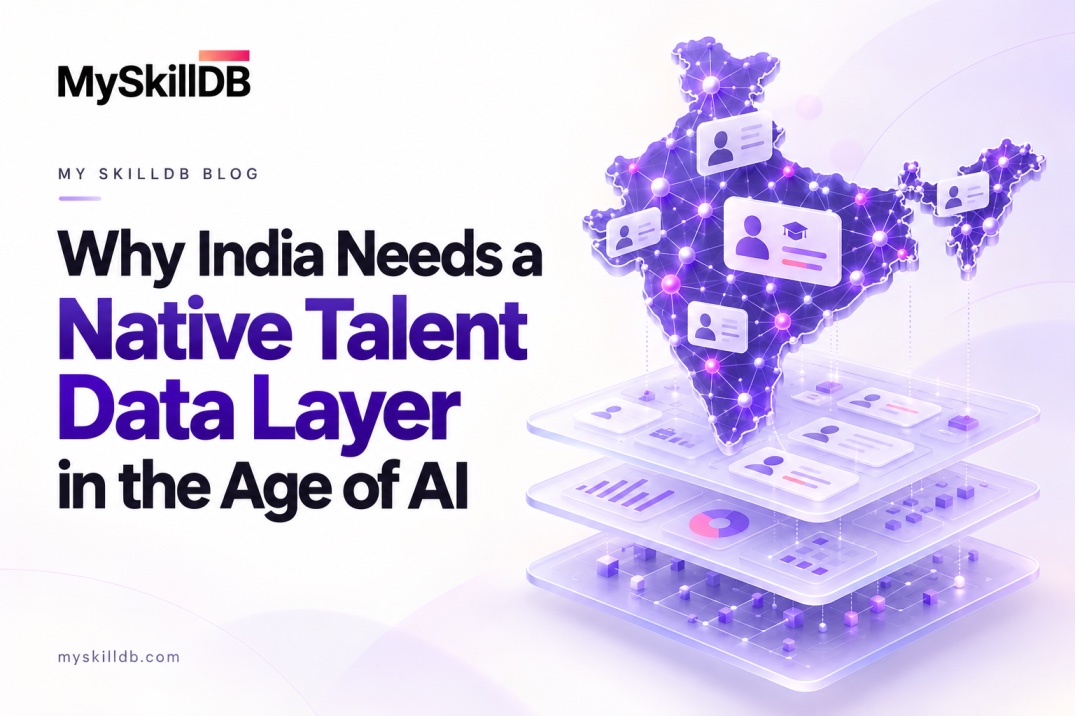
In this shift, one question matters more than most: who holds the data about our talent? At MySkillDB, we believe India's answer must be — India itself.
AI is rewriting the map of jobs and skills
AI models are absorbing routine tasks across support, operations, content, analysis and even parts of software development. At the same time, they are creating demand for new combinations of skills — people who can work alongside AI, interpret its outputs, and apply domain judgement where models fall short.
The result is a labour market that changes faster than our institutions can track it:
- Job descriptions evolve every hiring cycle, often quietly.
- Skill requirements differ sharply from one company to another, even for the same job title.
- Curricula are designed years in advance, while industry needs shift in months.
- Students graduate with degrees, but without a clear, verifiable picture of what they can actually do.
Whoever can see these shifts clearly — and early — holds a decisive advantage. That visibility comes from data.
What is a talent data layer?
Think of a talent data layer as the foundational record of a nation's workforce capability. Not just résumés and marks, but a living, structured map of:
- What skills people have — captured through assessments, projects, certifications and real work.
- What skills businesses need — derived directly from live job listings and the exact requirements of each company.
- How the two are moving — which skills are rising, which are fading, and where the gaps are widening.
When this layer exists, matching talent to opportunity stops being guesswork. It becomes a calculation.
Why it must be India-first
Today, much of the world's talent intelligence sits on global platforms, built for other markets and governed elsewhere. India's workforce is too large, too diverse and too strategically important to be understood only through borrowed lenses.
An India-first talent platform matters for several reasons:
- Context: India's education system, regional languages, district-level job markets and fresher hiring patterns are unique. A model trained on foreign hiring data will miss them.
- Sovereignty: Talent data is national infrastructure. It should be captured, stored and analysed on systems that answer to Indian institutions and Indian law.
- Reach: The real opportunity is not just in metro campuses, but in tier-2 and tier-3 colleges and training institutes where talent is abundant and visibility is scarce.
- Trust: Students, colleges and employers will share data more openly with a platform built around their needs and accountable to them.
Inherent servers, inherent analytics
Capturing talent data is only half the job. The other half is owning the intelligence built on top of it. A native talent data layer needs its own infrastructure and its own analytics engine — not a patchwork of exported spreadsheets and third-party dashboards.
With inherent servers and analytics, a platform can:
- Keep sensitive student and institutional data secure and under consistent governance.
- Continuously learn from every assessment, application and hire across the network.
- Surface patterns that no single college or company could see on its own.
- Deliver insights back to the people who generated the data — students, placement officers and recruiters — instead of locking them away.
Using AI the way it was meant to be used
Much of today's conversation about AI focuses on generation — writing, summarising, creating. But AI's deepest strength is older and quieter: calculating and predicting better than we can on our own.
Applied to talent, that means AI can:
- Predict which skills a given role will demand in the coming hiring seasons.
- Calculate how closely a student's skill profile matches a specific company's requirements.
- Identify the shortest learning path to close a student's skill gap for a target job.
- Help institutions decide which programmes, certifications and industry partnerships will matter most.
This is AI as an advisor to the economy, not a replacement for its people.
The right talent for the right business case
When talent and business needs are matched precisely, the benefits compound across the economy:
- Productivity rises because people are placed where their skills create the most value, and companies spend less time and money on mismatched hires.
- Happiness rises because people do work they are prepared for and suited to — reducing frustration, burnout and early attrition.
- Institutions improve because colleges get clear feedback on what industry needs and can adapt faster.
- Regions grow because local talent becomes visible to employers who would otherwise never have found it.
An economy that predicts its talent needs well doesn't just grow faster. It grows more fairly, and its people are more fulfilled.
How MySkillDB puts this philosophy to work
MySkillDB is built around this single idea: capture skills at the source, understand business needs at the source, and use AI to connect the two.
- Skills from real jobs: Our job-category courses and skill maps are derived from live job listings and the exact skills companies ask for — not from generic syllabi.
- Structured skill profiles: Through video-plus-assessment certifications that progress from basic to intermediate to advanced, every student builds a verifiable skill record over time.
- Precise matching: Our scoring models, such as the Skill Vector and Career Match Score, measure how well a student fits a specific role and company.
- Placement intelligence for institutions: Colleges and training institutes get a TPO Command Center, a growing partner-company and HR contacts database, and AI tools to find and engage companies hiring for their students' skills.
- Tools for students: AI Job Mentor, Resume Builder with ATS optimisation, Video CV Studio and interview preparation help students present what they can genuinely do.
Every interaction — a completed assessment, a matched job, a successful placement — strengthens the data layer, making the next prediction a little more accurate for everyone.
The road ahead
Our long-term goal is simple to state and ambitious to build: a repository of the skills every company requires, matched against a trusted, verified talent pool that companies can rely on. A native talent data layer for India — built here, governed here, and working for the people whose futures it shapes.
AI will keep changing what work looks like. The question is whether we will understand our own talent well enough to keep up. At MySkillDB, we are building so that India can.
If you are a college, training institute or employer who shares this vision, we'd love to work with you. Reach out to the MySkillDB team to see how your institution can become part of India's talent data layer.
Someone in your group chat needs this 👀
If it helped you, it’ll help them. Send it in one tap.
Comments 0
Sign in with Google to join the conversation.
Sign in with Google