
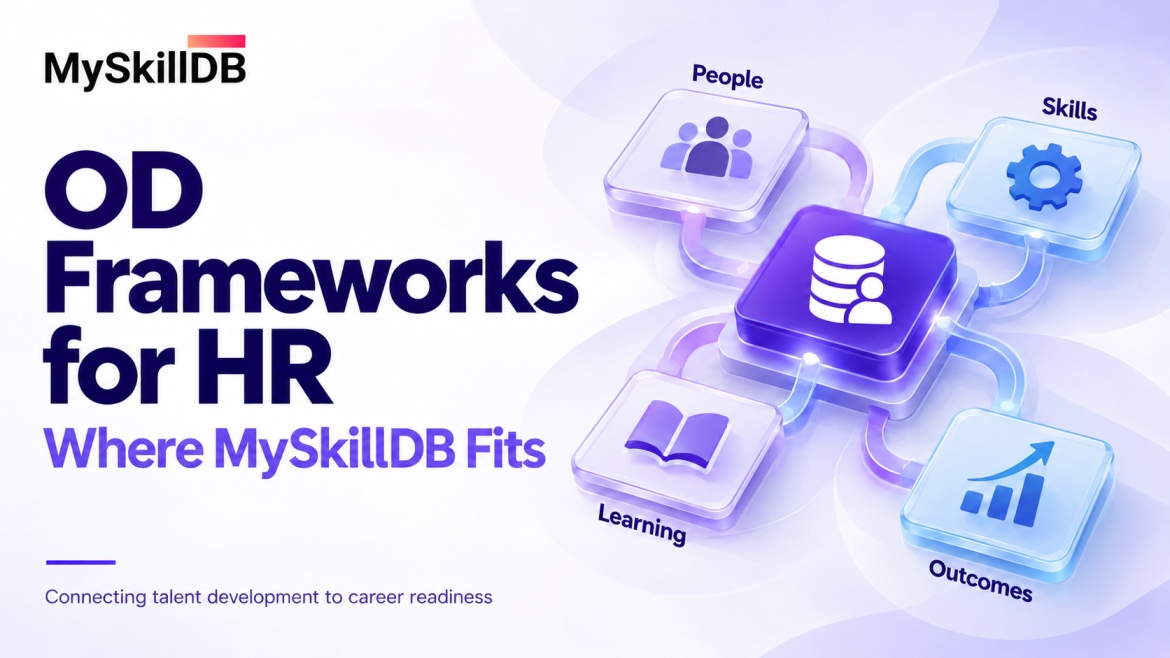
HR teams use Organizational Development (OD) frameworks to steer change inside the company. But most of those frameworks assume the skills problem starts after someone joins. In reality, it starts earlier: at campus hiring, fresher intake and the gap between what a job description asks for and what graduates can actually do. MySkillDB fills that gap as a skills-data layer that connects your hiring needs, and your HR systems, to the colleges and training institutes that supply your talent.
Why OD needs a skills layer at the talent entry point
Every OD intervention eventually hits the same wall: the people coming in don't have the skills the strategy needs. HR then spends months and budget on bridging programmes.
MySkillDB moves that work upstream. As an HR team, you can:
- Post jobs directly to partner colleges' and institutes' job boards through a recruiter login
- Define the exact skills each role needs, so institutes build job-specific courses against your live openings
- See verified skill data: assessment-backed certifications, Skill Vectors and Career Match Scores against your job categories
- Connect your HRMS or ATS via API so verified resumes, Video CVs and skill scores flow straight into the systems you already use
- Plug in AI assistants via MCP: connect MySkillDB to Claude or any MCP-compatible assistant to fetch resumes, compare candidates and run shortlisting analysis in plain language
The result is a hiring pipeline you can manage with the same rigour as any other OD programme. Below, we map MySkillDB to six frameworks HR leaders already use.
1. Lewin's Change Model: rethinking how you hire freshers
Lewin's unfreeze, change, refreeze model suits moving campus hiring from a yearly event to a managed pipeline.
- Unfreeze. Show the cost of the current approach: long time-to-productivity, high early attrition and repeated bridge training.
- Change. Publish your role requirements through MySkillDB. Partner institutes train students against them with assessment-coupled certifications, and you shortlist on verified skills, not marks alone.
- Refreeze. Make skill-based shortlisting your standard campus SOP and wire it into your HRMS through the API, so it runs every cycle without manual effort.
2. Kotter's 8 Steps: leading a skills-first hiring transformation
Kotter's model suits HR leaders who need buy-in across business units.
- Create urgency. Quantify the gap between new-hire readiness and role expectations, and its cost in training and attrition.
- Build a guiding coalition. Bring in hiring managers, L&D and talent acquisition to define what "ready" means for each role.
- Form a strategic vision. Commit to hiring on verified, role-specific skills rather than degrees and generic aptitude tests.
- Communicate the vision. Share skill requirements with partner institutes through MySkillDB so they train toward them.
- Remove barriers. Replace manual campus coordination and resume downloads with direct job posting and API sync into your HRMS.
- Generate short-term wins. Track the first cohort hired through skill-matched shortlists: faster onboarding and fewer early exits.
- Sustain acceleration. Update role requirements as the business changes; institute courses follow your live jobs.
- Anchor it in culture. Make skill-based hiring part of your workforce plan and hiring-manager scorecards.
3. ADKAR: preparing new hires before Day 1
ADKAR tracks change one person at a time. With MySkillDB, much of a new hire's ADKAR journey happens before they join.
- Awareness. Candidates see your role's skill requirements and their own Career Match Score against it.
- Desire. A real opening with your company's name gives students a concrete reason to upskill.
- Knowledge. Institutes run job-specific courses built against your live job requirements.
- Ability. Assessment-coupled certifications and real business problems prove candidates can apply skills, not just recall them.
- Reinforcement. Internship introductions and offers reward the effort; L&D picks up from a known skills baseline.
ADKAR applies to hiring managers too. Moving them from "gut-feel interviews" to skill-data shortlists is a change in its own right. Querying candidates through an AI assistant over MCP makes it easier.
4. McKinsey 7S: where MySkillDB sits in your organisation
In 7S terms, MySkillDB is a System that strengthens Skills and Staff, and through them supports the other four elements.
Hard elements
- Strategy. Workforce plans translate into concrete role-skill requirements that partner institutes train toward.
- Structure. Talent acquisition, L&D and hiring managers share one view of incoming talent, not separate spreadsheets.
- Systems. MySkillDB sits upstream of your ATS and HRMS, feeding verified skill data and resumes through API, with MCP access for AI-driven analysis.
Soft elements
- Shared values. Hiring on demonstrated skill signals fairness and merit, which strengthens employer brand on campus.
- Style. Hiring decisions move from intuition to evidence.
- Staff. New hires arrive closer to role-ready, reducing pressure on managers and L&D.
- Skills. You build a repository of the skills each role actually needs, refined with every hiring cycle.
If your strategy calls for new capabilities but your systems still hire on degrees alone, MySkillDB closes that misalignment.
5. Burke-Litwin: diagnosing skills and performance gaps
Burke-Litwin links the external environment to performance. It separates leadership-and-culture problems from skills-and-systems ones.
- External environment. Shifting market job requirements show which skills are becoming scarce before they hit your hiring targets.
- Mission and strategy. Each strategic priority translates into job categories with defined skill sets.
- Systems. Skill-matched shortlisting, institute partnerships and HRMS integration replace generic campus drives.
- Task requirements and individual skills. This is where MySkillDB is strongest: role requirements on one side, verified candidate skills on the other, measured as a Career Match Score.
- Motivation. Candidates who trained specifically for your role arrive with clearer intent.
- Individual and organisational performance. Better role fit at entry means faster ramp-up and higher team productivity.
If your diagnosis points to skills, systems and task fit, MySkillDB gives you data to act on.
6. Ulrich's HR Model: MySkillDB for each HR role
Dave Ulrich's model defines four roles HR plays in an organisation. MySkillDB supports each of them.
- Strategic partner. Turn business plans into role-skill requirements and a pipeline trained against them before you hire.
- Change agent. Lead the shift from degree-based to skills-based hiring with data that hiring managers can see and trust.
- Administrative expert. Post jobs directly, sync resumes into your HRMS via API, and let an AI assistant pull and compare profiles over MCP instead of sifting files by hand.
- Employee champion. Give new hires a fair, transparent path in: they know what the role needs, train for it and are assessed on it.
Our own proof point: MySkillDB's in-house engineering team is made up of freshers we trained this way, and they now build our websites, web apps and the platform itself.
Picking the right framework
- Changing how you hire? Use Lewin or Kotter.
- Worried about new-hire readiness or manager adoption? Use ADKAR.
- Not sure where the problem sits? Diagnose with 7S or Burke-Litwin.
- Repositioning HR as a strategic function? Use Ulrich's roles.
In each case, MySkillDB plays the same part: the skills-data layer between your workforce plan, your HR systems and the institutions that supply your talent. OD frameworks tell you what to change. MySkillDB makes sure the people walking in are ready for it.
Partner with MySkillDB
If you lead HR, talent acquisition or L&D, join MySkillDB as a recruiter partner. Share your role requirements, connect your HRMS or AI assistant, and hire from a talent pool trained for your needs. Book a demo to see the recruiter view and integrations in action.
Someone in your group chat needs this 👀
If it helped you, it’ll help them. Send it in one tap.
Comments 0
Sign in with Google to join the conversation.
Sign in with Google