
Data current as of October 2026
On October 27, US wealth-tech firm AssetMark opened its new Global Capability Centre in Hyderabad, with room for about 500 people. For its first group of campus hires, it didn't run a nationwide drive or open a portal to thousands of applicants. It chose one college, CBIT, and planned to take 10 to 15 graduates.
AssetMark was one of at least six GCCs to open or expand in India in October alone. And that is how a growing share of good fresher jobs in India is now filled. Placement officers who understand this shift will place more students over the next three years than those still waiting for the next mass drive.
The hiring didn't disappear. It moved.
Ask any placement cell about 2026 and you'll hear the same worry: the big services drives are thinner. That's true, but it's only half the story.
India had about 1.23 lakh active tech openings in October 2026, the highest in 18 months. Global Capability Centres, the in-house India offices of multinational companies, are on track to hire around 5 lakh people this year. India opened 111 new GCCs in the first eight months of 2026 alone.
The catch is in how they hire. Freshers make up only about 1 in 8 active tech openings, and most GCC hiring targets people with 3 to 8 years of experience. When GCCs do hire freshers, they hire small batches, from a few campuses, and they expect proven skills.
So the question for your college isn't "Are companies hiring?" It's "Are we one of the campuses they hire from?"
October 2026 alone: the GCC wave in one month
If you need proof that this is happening now, look at a single month.
New centres and expansions
- AssetMark (Hyderabad, Oct 27): opened a GCC built for about 500 people, with hiring underway at every level, from senior leadership to fresh graduates. Its first campus batch is 10 to 15 graduates from one college.
- Blackstone (Bengaluru, Oct 27): opened its first global capability centre outside the US.
- RSM (Bengaluru, Oct 28): expanded its GCC with a 154,000 sq ft facility.
- Augury (Bengaluru, Oct 15): opened a hub to grow its industrial AI capabilities.
- thyssenkrupp Automotive Technology (Pune, Oct 9): inaugurated a new GCC.
- HCLTech with AWS (Lucknow, Oct 27): launched an AI-powered GCC Centre of Excellence.
Who is building more of them
- LTM (formerly LTIMindtree) launched GCC Origin on Oct 28, a dedicated unit that helps global companies set up and run GCCs across Tier 1 and Tier 2 cities.
- Uttar Pradesh released a GCC policy on Oct 27 aiming to attract more than 1,000 new GCC units and create 5 lakh jobs, including in Tier 2 and 3 cities.
The numbers behind it
- 18,000 active GCC tech openings in October, up 64% from a year earlier and about 15% of all tech openings in India.
- 1 to 1.4 million net new GCC jobs by 2031, with an estimated 590 to 640 new GCC setups still to come from large global companies that don't yet have one in India.
- About 67,000 healthcare GCC roles in demand in 2026 across 155 companies. But entry-level demand in this segment fell 12.4% year on year in Q2. The jobs are growing, yet freshers have to be visibly job-ready to get them.
Every one of these new centres needs its first campus partners, and most will pick only a handful of colleges. The window to become one of them is open right now.
What is a feeder campus?
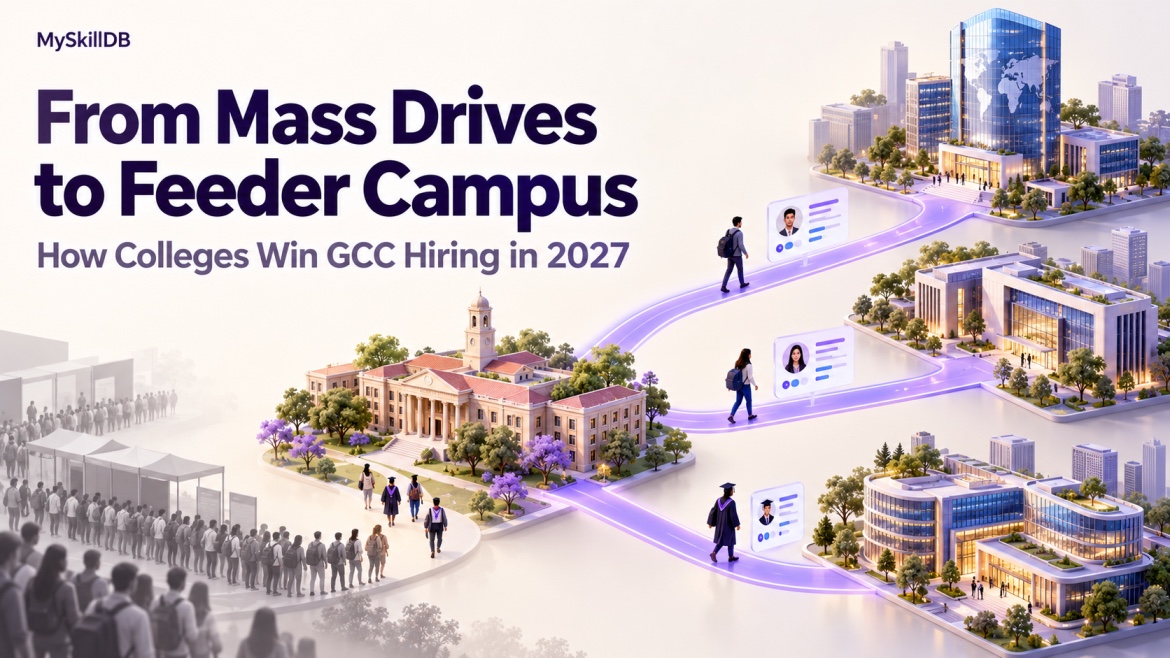
A feeder campus is a college that a company returns to every year for a steady supply of entry-level talent. It isn't a one-time drive. It's a relationship.
In year one, a GCC might take 10 students. If those students perform, stay, and need less training, the company comes back in year two with a bigger batch, often for more than one team. By year three, your alumni inside the company are referring juniors, and your college has become part of its hiring plan.
For a GCC, a reliable feeder campus saves time, cuts training cost and lowers early attrition. For a college, it means placements that grow every year instead of starting from zero each season.
Why GCCs hire this way
Three trends make the feeder model the default for GCC fresher hiring.
1. They need skills, not just headcount. Nearly two in three new GCC roles now require AI, data science or automation skills. A GCC can't afford to train 500 generalists. It would rather take 15 students who already know the basics.
2. Early-career hiring is growing, but in small numbers. Hiring for people with 0 to 3 years of experience makes up about 30% of GCC hiring and is the fastest-growing segment. Because each new centre starts small, that demand is spread across many companies taking modest batches, not a few running mass drives.
3. New GCCs are moving beyond the metros. As GCCs expand into Tier 2 cities, they need local campus partners. A new centre has no hiring history, no alumni network and no campus relationships. The colleges that show up early, organized and prepared get chosen first.
What GCCs look for before picking a campus
Placement officers often assume companies choose campuses on rankings. Rankings help, but GCC recruiters weigh a few practical things more heavily.
- Proven skills, not just aptitude scores. Projects, skill assessments and verified profiles matter more than a single online test result.
- Consistency across the batch. One brilliant student doesn't make a campus. Recruiters want confidence that the 10th student is as ready as the first.
- An easy, responsive placement cell. Fast shortlists, clean student data and one clear point of contact make the recruiter's job easier, and they remember it.
- Interns who convert and stay. Strong internship performance and low early attrition are the biggest reasons a company returns.
The feeder campus playbook: 5 steps
Step 1: Pick the right three targets.
Don't chase every GCC. Shortlist three that fit your strengths. A commerce-heavy college might target BFSI and finance operations centres. A college with strong life-science departments should look at healthcare GCCs, which expect demand for over 6,000 regulatory and quality roles and over 4,000 data and AI roles in 2026. Start with centres that opened in the last 6 to 12 months, like the October launches above. They have no campus relationships yet.
Step 2: Build a skill-proven student pool.
Before you approach a company, have a ready shortlist of 20 to 30 students with verified skills, completed projects and up-to-date profiles. When a recruiter asks "Who do you have for a data analyst role?", you should be able to answer within a day, not a month.
Step 3: Start with internships.
An internship is the lowest-risk way for a GCC to test your campus. Offer a small, well-prepared group of interns. Their performance becomes your strongest pitch for full-time hiring.
Step 4: Make the recruiter's job easy.
Send shortlists within 48 hours. Share clean data in the format they ask for. Assign one coordinator who follows up. Small acts of organisation set your campus apart from colleges that take weeks to reply.
Step 5: Track outcomes and report back.
After students join, keep track of how they're doing: conversion from intern to full-time, retention at six months, performance feedback. Share a short report with the company before the next hiring season. Very few colleges do this, and it's what turns a one-time hire into a yearly relationship.
What success looks like by year three
- Year 1: One or two GCCs take a small batch of interns or freshers from your campus.
- Year 2: Batch sizes grow, and new teams within the same company start hiring.
- Year 3: Your alumni inside the company refer juniors, more GCCs approach you, and placements become predictable instead of seasonal.
The colleges that start this process now, while hundreds of new GCCs are still building their teams, will hold an advantage that's hard for others to catch up with.
Become a feeder campus with MySkillDB
Becoming a feeder campus starts with knowing exactly which students are ready, for which roles, and being able to prove it to recruiters. MySkillDB helps placement cells build verified, recruiter-ready student pools, track skill readiness across every batch, and respond to company requests in hours instead of weeks.
Book a demo to see how your college can become the campus GCCs return to every year.
Sources
- Xpheno Active Tech Jobs Outlook, October 2026 (via Lapaas Voice)
- Entry-level share of tech openings (Beincareer)
- foundit GCC hiring data (Business Today)
- ANSR GCC experience mix (SuccessCDS)
- 111 new GCCs, January–August 2026 (Whalesbook)
- AssetMark Hyderabad GCC (CXO Today)
- LTM GCC Origin and Blackstone (Elets CIO)
- RSM, Augury, thyssenkrupp (GCC Index)
- Uttar Pradesh GCC policy and HCLTech CoE (Business Standard)
- Embark GCC outlook to 2031 (YourStory)
- Quess Healthcare GCC Outlook 2026 (Medical Buyer)
- Healthcare GCC entry-level demand (OffCampusJobs4u)
Someone in your group chat needs this 👀
If it helped you, it’ll help them. Send it in one tap.
Comments 0
Sign in with Google to join the conversation.
Sign in with Google